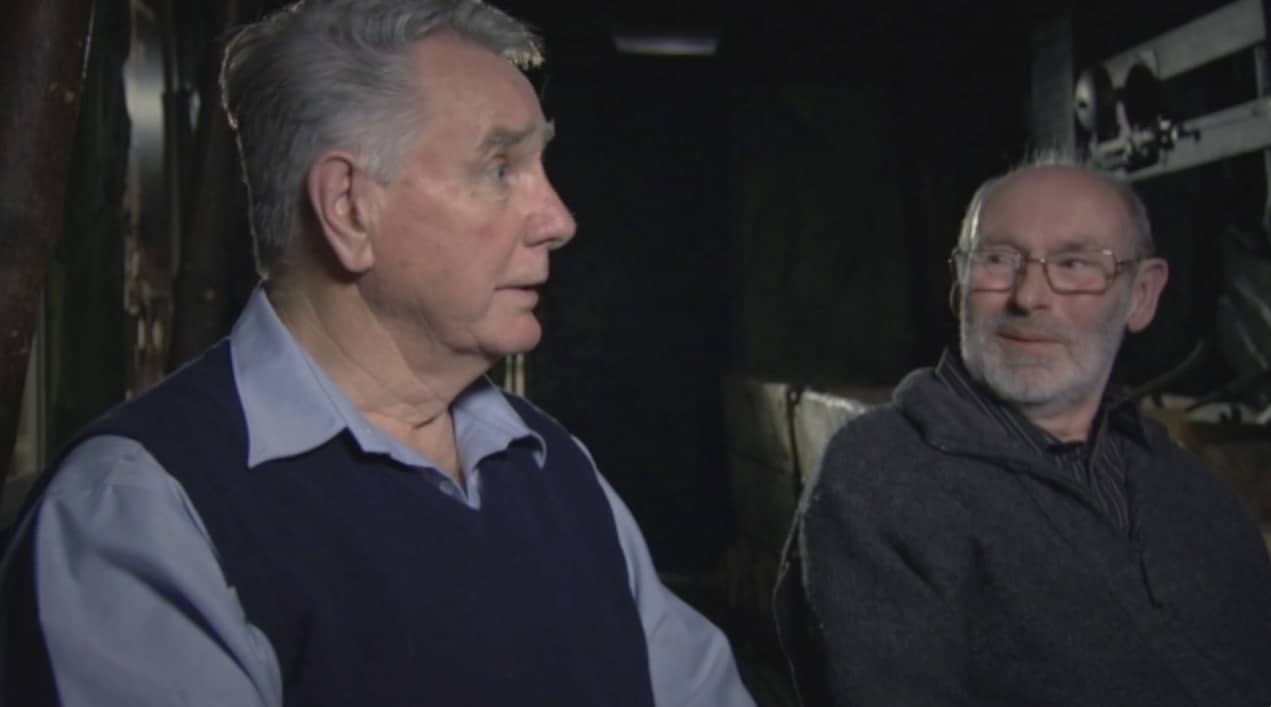
In October 2016, fifty years after the last trains ran on the Somerset & Dorset, a BBC crew came to Radstock to record what was left of the line and of the coalfield it served. Our Chairman, Bryn Hawkins – who first went underground at the age of fifteen – met them alongside an amateur filmmaker whose cine footage had captured the last working years of the Somerset pits.
Arriving by bus, as everyone did after 1966
The crew reached Radstock the way most people had to once the trains had gone: by bus. The one they travelled on was built in Bristol in 1948, exactly the sort of vehicle that was expected to take over from the railways as the lines closed.
“A single to Radstock, please. How much is that?”
“In 1966 that would be four old pence.”
“I’ll settle for 1966 prices.”
It was said lightly, but the point behind it was serious enough. Buses were the official answer to closure, and for a great many people in the former coalfield villages they were not much of an answer at all.
Coal kept the line alive
Once the through passenger trains had been taken away, the Somerset & Dorset came to depend more and more on local goods traffic, and above all on coal. Much of it was bound for Portishead power station. The railway and the collieries had grown up together, and when one went, the other did not last long behind it. The last shift in the Somerset coalfield was worked in 1973.
The incline
The most striking thing in the old film was the incline. Coal mined up in the hills was brought down in wagons to the railway lines in the valleys, and those wagons ran with nobody aboard, controlled by a cable.
“The heavy wagons, the loaded wagons, are going down and they’re pulling the empty wagons up,” Bryn explained. Gravity did the work. The weight of the full wagons descending was what hauled the empty ones back up to the top.
When a wagon ran away
It did not always go to plan.
“I can remember going out there several times,” Bryn said. “We had to get a set of cutters out there, because the chap on the top had not attached the loaded wagons to the cable. So it careered all the way down and smashed up down the bottom. So we had to go down with the set of cutters to cut the wagon up, because it was in the way.”
That is a mining engineer’s account of an accident. There is no drama in it, only a wrecked wagon blocking the road and a job that had to be done before anything else could move.
The man in danger was the one at the bottom
The man at the top of the incline had a large brake, which he used to try to slow the wagons on their way down. It was, as Bryn put it, “a bit of a job.”
Asked whether the brakeman was not himself in danger, Bryn was clear that he was not the one to worry about. “It was the poor chap at the bottom that was in danger” – certainly if the wagons ever actually ran away.
A world that has passed away
Steam locomotives, open coal wagons, and unmanned trucks worked up and down a hillside on a cable. It is a description of a place that no longer exists anywhere in Somerset. Asked why he had gone to the trouble of filming it all those years ago, the amateur filmmaker gave the simplest answer there is: he thought it ought to be captured.
That instinct is the only reason any of it survives to be shown. The Somerset District Miners Welfare Trust exists for much the same reason, to make sure the coalfield is remembered by the people now living on top of it. Bryn has gone on to tell these stories on his radio series When Coal Was King, and the trust’s metal miners now stand in villages right across the former coalfield as a permanent reminder of the men who worked below.
If you have photographs, film or memories of the Somerset pits, or of the railway that served them, we would very much like to hear from you. Please visit our contribute page to get in touch.